Regenerative Tourism
Cabo Pulmo: the reef that came back to life (and how to visit without taking anything)
August 4, 2026
There's a stretch of coast on the East Cape where the water changes texture. It isn't a trick of the light: it's biomass. Schools of jack closing in on themselves, groupers the size of a child resting under fingers of coral, bull sharks passing without hurry because nobody has chased them in thirty years. Cabo Pulmo holds more life per cubic meter of sea than anywhere else in the Gulf of California, and that didn't happen by accident or by distant decree.
It happened because a handful of families who lived by fishing decided to stop. That's the part that almost never gets told when Cabo Pulmo comes up as "the most studied reef in the world". The scientific figure is extraordinary, but it's the human one that explains it. This piece is about both: what happened there, and how to visit in a way that honors what it cost.
What Cabo Pulmo actually is
Cabo Pulmo is a marine National Park on the east coast of the municipality of Los Cabos, Baja California Sur, between La Paz and San José del Cabo, and it protects 7,111 hectares of sea and shoreline. Its value isn't scenic: it's geological and biological. The Cabo Pulmo reef is the only living coral reef in the Sea of Cortez, the northernmost in the eastern Pacific and one of the oldest in North America, with an estimated age of some 20,000 years: the reefs of Panama, by comparison, barely pass 5,000.
Its structure looks nothing like a Caribbean reef. Here the coral grows in finger-like formations dominated by Pocillopora, Porites and Pavona, over a rocky bottom that reaches toward open water in parallel fingers. Of the fourteen hermatypic coral species recorded for the Gulf of California, eleven live on this reef. In practical terms, it's an island of coral surrounded by underwater desert.
Since 2005 Cabo Pulmo has been inscribed as one of the components of the serial property "Islands and Protected Areas of the Gulf of California", declared World Heritage by UNESCO. It's worth saying in full: that property has been on the List of World Heritage in Danger since 2019, and not because of anything happening here, but because of the critical situation of the vaquita more than a thousand kilometers north, in the Upper Gulf.

What happened: the decision that changed the reef
In the early nineties, Cabo Pulmo was empty. Not of people, of fish. Decades of commercial and trawl fishing had left the reef in a state the fishermen themselves described as a desert: you had to go farther out each time to bring back less.
The village grew up around pearl diving and the extraction of mother-of-pearl, an activity documented here since the early twentieth century. What came next is what matters: in 1995 the fishing families of Cabo Pulmo —the Castro family among them— pulled their nets out of the water and pushed for the protected area, after years of work with academics, civil organizations and authorities to change their way of life without being uprooted from it.
On June 6, 1995 the reef and beaches of Cabo Pulmo were declared a protected natural area with the status of National Marine Park, covering 7,111 hectares, on the community's own initiative and with the backing of scientists and government. In 2000, after a reform to the LGEEPA eliminated that category, an agreement published in the Diario Oficial de la Federación on June 7 recategorized it as Cabo Pulmo National Park. Its management program was published in 2009.
What matters is that the area became a no-take zone and, unlike so many protected areas that exist only on paper, enforcement worked, because the people doing the watching were the people who lived there.

The numbers behind the recovery
This is where Cabo Pulmo becomes a case study and not just a good story.
In 1999, four years after the decree, fish biomass inside the park was not significantly different from that of other protected or open-access areas in the Gulf of California: around 0.75 tonnes per hectare. Ten years later, in 2009, total biomass inside the park had risen to 4.24 tonnes per hectare. An increase of 463 percent. Top predator biomass multiplied elevenfold, and carnivore biomass fourfold. Over the same period, biomass in the Gulf's other protected areas and open-access zones did not change significantly.
The study that documented this (Aburto-Oropeza et al., published in PLoS ONE in 2011 under the title "Large Recovery of Fish Biomass in a No-Take Marine Reserve") concluded it was the largest increase in fish biomass ever measured in a marine reserve anywhere in the world, and put the result down to a combination of ecological and social factors: strong community leadership, social cohesion and effective compliance with the rules.
That last sentence is worth reading twice. The science didn't say the reef recovered because the ecosystem was resilient. It said the reef recovered because the community held to its decision for a decade, when nobody could guarantee it would work.

Getting there
Cabo Pulmo is roughly 60 kilometers by road from San José del Cabo and about 135 from La Paz. From either one you take Federal Highway 1 to the community of Las Cuevas, and from there the paved road toward La Ribera. Just before La Ribera you turn south onto some 20 kilometers of asphalt that eventually turns to dirt.
Driving times run about two hours from the Los Cabos tourist corridor, an hour and a half from the East Cape and close to two hours forty-five from La Paz. The last dirt stretch is around 10 kilometers and, while any vehicle handles it under normal conditions, take extra care in the rainy season (September), when the arroyos that cross the road can turn dangerous.
One detail that changes how you plan: the village has no piped drinking water, power is mostly solar, and the nearest gas station, ATM and medical service are in La Ribera, some 27 kilometers away by road. Come with cash, a full tank and water.
What you can do, and who with
The way to see the reef is from the water and at the surface: snorkeling and diving, always on boats run by local guides authorized by the park authorities. That isn't a stylistic recommendation, it's the site's operating rule.
Groups are deliberately small, and the limit isn't a custom: it's written into the park's management program. Up to eight people per instructor for free diving and six for scuba inside the Preservation Subzone, with the instructor accompanying the group the whole way.
The tourism operators working in the village need authorization from SEMARNAT to work inside the park. Before booking, check with the Cabo Pulmo National Park office that your operator holds a current authorization: there's no public registry, so the query goes straight to CONANP.
No activity inside the park boundary can be extractive. No sport fishing, no subsistence fishing, no collecting. That is, literally, the mechanism that produced the 463 percent.

The rules that matter (and why)
- Don't touch the coral, not with your hands and not with your fins. The Pocillopora formations are structural: what breaks doesn't come back in a season, it comes back in decades.
- No sunscreen with oxybenzone or octinoxate. Physical protection (long-sleeve rash guard, hat) before chemical.
- Don't anchor outside the authorized zones. An anchor does in a minute what the reef takes years to rebuild.
- Don't chase wildlife. The bull sharks, the manta rays and the schools of jack come close precisely because nobody chases them. That's the deal.
- Leave nothing behind. No collecting shells, coral or sand, and no waste, organic included.
Best season
Surface temperatures recorded inside the park and collected in its management program range from about 20 °C in March to close to 30 °C toward August and October. The warm months, from late July to November, are usually the ones with the best conditions for swimming and diving. Winter brings colder water and more wind, but also more megafauna moving through the Gulf corridor. September is the month with the highest chance of rain and of closures for sea conditions, so leave slack in your itinerary.
There's no systematic published record of visibility —the management program says as much itself— so treat any average figure with suspicion: it shifts with swell and wind fronts, and the sensible move is to check the local report before you travel.
Common mistakes
The first is showing up without booking. Capacity per departure is small and in high season the boats fill days ahead. The second is treating Cabo Pulmo as a half-day stop from Los Cabos: between the drive, the time on the water and the return, the day is gone, and rushing it is the most efficient way to see nothing. The third is assuming there are services: there aren't, and that scarcity is part of what has kept the village small. The fourth, and the costliest, is going looking for the reef on your own by kayak or from the beach without a guide; besides being restricted, it's the most common way to damage coral without realizing it.
Who this trip is for (and who it isn't)
It's for anyone who travels to Baja California Sur wanting to understand something, not just look at it. For anyone who takes a dirt road, a village with no tourist infrastructure and a day on the water in groups of six or eight as part of the value and not as a shortcoming.
It isn't for anyone after nightlife, a resort or beach service. And it isn't, in the strictest sense, a destination of "more": Cabo Pulmo works because little is asked of it.

What Cabo Pulmo taught us
We don't operate in Cabo Pulmo. We bring it up here because it's the clearest proof of the idea behind everything we do: when caring for an ecosystem generates more value than extracting from it, conservation stops depending on goodwill and starts holding itself up.
It's exactly the arc we see at the other end of the East Cape, in La Ventana and El Sargento, where we work with Nativo Expediciones, a family who lived for generations from small-scale fishing and today run ecotourism expeditions in the Sea of Cortez. The same decision, made at another point on the map and on another timeline: trade extraction for access, and find that the sea gives more when it's left to be.
It took Cabo Pulmo a decade to teach the world that with data. The lesson seems to come down to something simple: ecosystems don't need us to save them, they need us to stop charging them. They handle the rest.
Our expedition in the Sea of Cortez
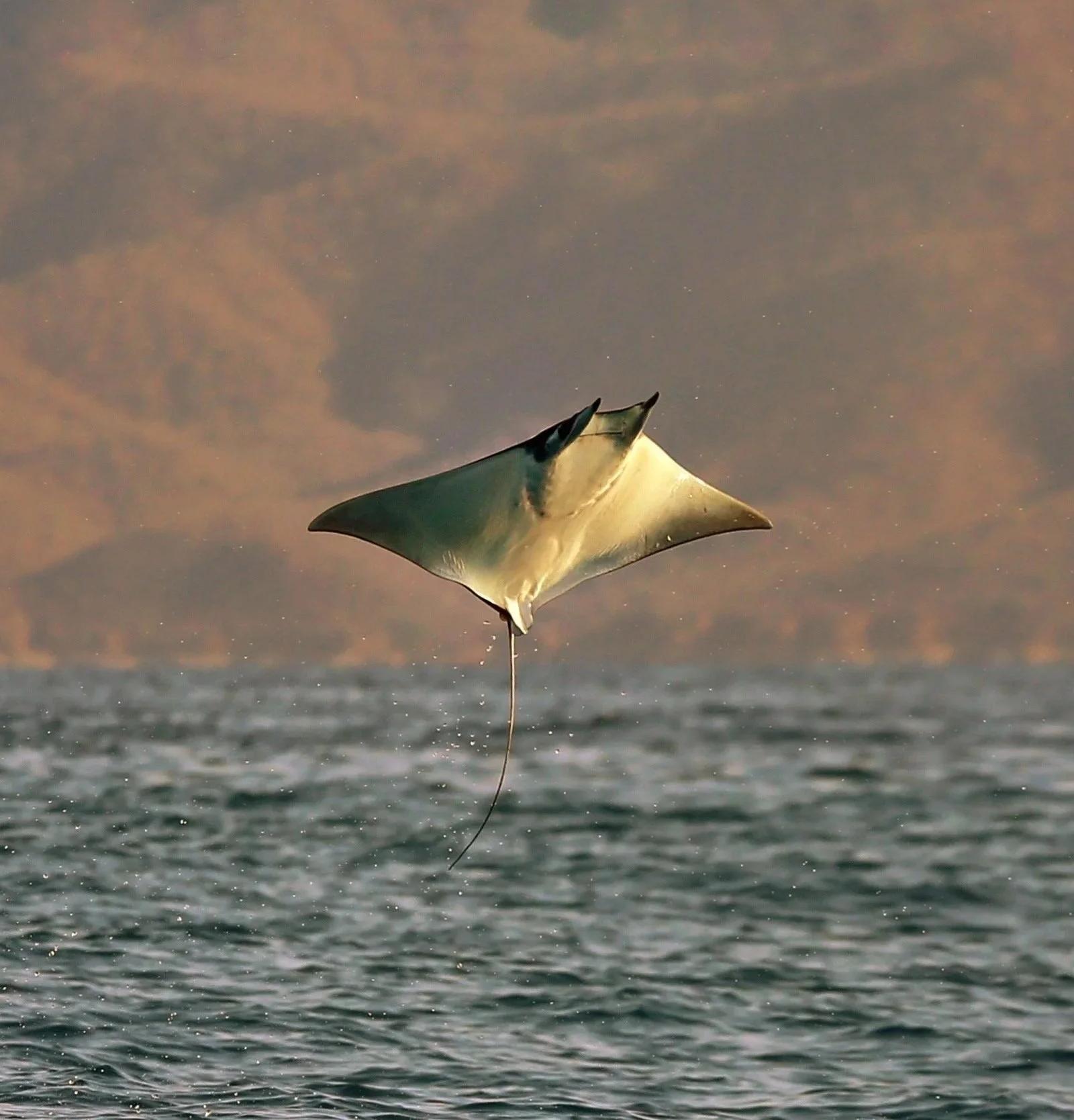
If this story moved something in you, the Sea of Cortez is best travelled slowly and in small groups. Our camp in La Ventana is a few hours from Cabo Pulmo, on the same gulf, and there we run four days among mobula rays, megafauna, wind and desert, on the same low-impact principle: a reversible camp, limited capacity and a share of the income that stays where it should stay.
Take a look at the Móbulas & Megafauna Safari in La Ventana, or check the calendar of upcoming expeditions to put your dates together.
See you out there.