Regenerative Tourism
Regenerative tourism vs. ecotourism: they’re not the same thing (and why the difference matters)
July 1, 2026
These days almost every trip is sold as “green”: eco-hotels, eco-tours, eco-lodges, sustainable glamping. The label has become so common that it stopped meaning anything, and somewhere along the way we lost a distinction that does matter. A trip that promises to do no harm isn’t the same as one that sets out to leave the place better than it found it. That difference, almost invisible while you’re planning a trip, is the line between ecotourism and regenerative tourism. It’s worth understanding before you choose where to go.

What ecotourism is (and where it stops)
Ecotourism was born of a good intention: travel into wild places while keeping impact low, respecting wildlife, teaching the traveler something. It is a step up from extractive mass tourism, and we owe it a great deal. But the bar is low. At its best, the goal of ecotourism is to do no harm: leave the smallest possible footprint, take only photographs, carry nothing away.
The problem is twofold. First, “do no harm” has become easy to claim and hard to verify, and that is where greenwashing thrives. Second, and more fundamental: in ecosystems that are already wounded, doing no harm isn’t enough. When a place has lost half its life, holding it steady freezes the loss rather than reversing it. And that is exactly where much of our ocean stands.
The real state of the ocean (why “do no harm” is no longer enough)
The numbers are sobering. The planet’s living coral cover has halved since the 1950s, according to a study published in One Earth and reported by the Natural History Museum in London (NHM, 2021). Over the same period, reef-associated biodiversity fell by more than 60%. In fisheries, the most recent FAO assessment estimates that around 35% of marine fish stocks are overexploited, with overfishing growing by close to 1% a year (FAO, 2025).
Against an ocean like that, passive conservation isn’t enough. Not breaking things no longer does the job: the work now is repair. Which brings us to another idea.

What regenerative tourism is
Regenerative tourism borrows its framework from the regenerative economy, a concept the financier John Fullerton, a former JPMorgan executive, set out in 2015 in his essay Regenerative Capitalism (Capital Institute). His thesis is elegant: economic systems should behave like living systems, which don’t merely sustain themselves but produce and regenerate in the same motion. Nature doesn’t “reduce its impact”; a forest, as it grows, improves the soil, the water and the air around it.
Applied to travel, regenerative tourism changes the question. It’s no longer “how do I do less harm?” but “how do I make my presence leave the ecosystem and the community better than I found them?” The bar rises from doing no harm to regenerating.
The key difference, in a sentence
Ecotourism aims to leave the smallest footprint. Regenerative tourism aims to leave a positive one. One measures success by what it avoids; the other by what it creates: hectares protected, species recovering, families who give up trawling because looking after the sea feeds them. It’s a difference of ambition, and that’s why it matters. On a half-repaired planet, aiming only to not make things worse is aiming at very little.
True Cost Accounting: why the extractive model only looks cheaper
There’s an economic reason the extractive model keeps winning, and it has a name: it doesn’t pay for what it destroys. The True Cost Accounting framework, developed by Pavan Sukhdev in the TEEB study for UNEP (2010), puts it plainly: an activity that strips a mangrove, empties a fishery or bleaches a reef looks cheaper only because its price leaves out the cost of that destruction. Someone pays it later, almost always the local community and the ecosystem.
Once those costs are counted in, the numbers flip. The regenerative model, more expensive at first glance, turns out to be the one that actually adds up, because it doesn’t pass its bill to the future. This is the basis of our thesis: the goal isn’t to stay out of the way, but to conserve faster than we extract, aligning the economic incentive with the health of the place.

The Akampa case: what regenerating looks like, in numbers
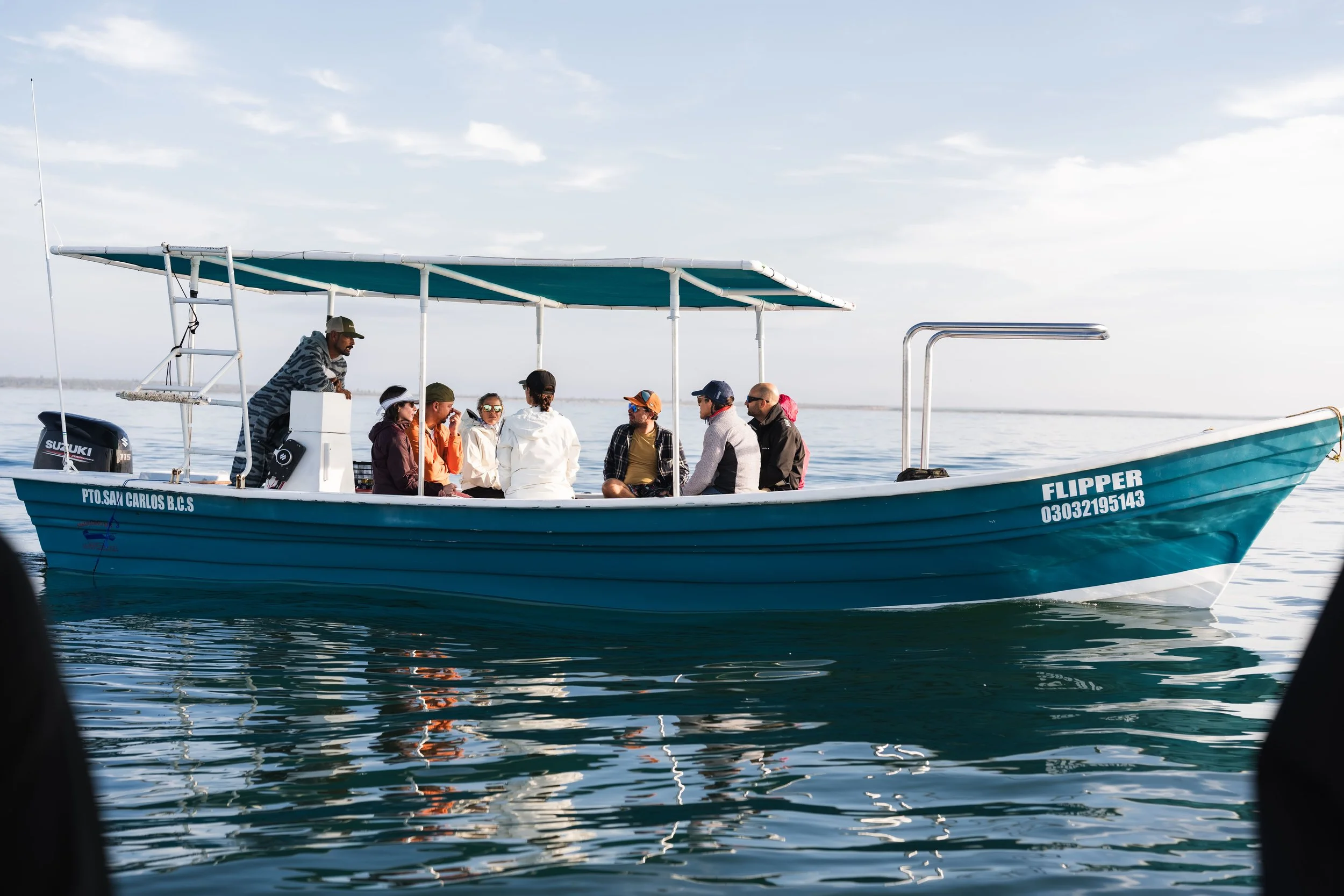
A living thesis without proof isn’t enough. Ours is being tested in Magdalena Bay, Baja California Sur, where we’ve been operating under this model for about four years. We tell the full story in our Magdalena Bay guide, but what matters here are the numbers, because we believe regeneration is something you measure.
In 2025, our operation put close to MX$7.4 million into the local community, with 13 direct jobs and 25 indirect ones. We separate around 70% of our waste and take close to 99% of the trash we find out of the ecosystem. Our tents work on a take-down-and-put-back principle: prefabricated, no foundations, no rebar, installed in a fully reversible way that leaves the structure of the ground untouched. And we use maximum guest capacity and seasonality as deliberate conservation tools: the philosophy is to scale revenue without scaling impact.
None of these figures is perfect, and that’s exactly the point. They’re honest, they’re measured and they’re published, because a regenerative model that doesn’t account for itself is just another form of greenwashing. Our roadmap points to 100% solar power and partnerships with scientific institutions over the next few years.
How to spot a regenerative trip (5 key questions)
If you’re deciding where to travel, these questions separate the regenerative from the cosmetic:
- Who keeps the money? A regenerative trip leaves direct, verifiable income in the local community, not only with an outside operator.
- Are there numbers, or only adjectives? If sustainability is announced in pretty words without a single measurable figure, be suspicious.
- Is the community a host or a backdrop? Look for local people running the operation, making the decisions and benefiting from it, not just appearing in the photos.
- Is the infrastructure reversible? What gets built to last forever is rarely low-impact.
- Are capacity and season limited on purpose? Deliberate scarcity is a sign that the place matters more than the volume.
It’s the same logic we work through in our piece on conservation tourism in Mexico: the label tells you nothing; the mechanism tells you everything.
Why this distinction matters so much to us
We insist on the difference between regenerating and doing no harm because the future of places we love turns on it. If travel only avoids damage, the sea keeps losing ground, more slowly perhaps, but losing it. If travel can regenerate, then every expedition becomes an economic vote for nature left standing being worth more than nature extracted. That’s the bet, and it can be checked.
You can read our model and its figures in detail on our Impact and about us pages. And if you want to see it in person, our expeditions in the Sea of Cortez are the most direct way to turn your trip into conservation.